The reference 'author' used
in my response refers to 'Wakas'.
My article below was used as the source of
the attempted critique by Wakas:
THE FIVE PRAYERS
FROM THE QURAN
http://quransmessage.com/articles/the five prayers from the quran
FM3.htm
The common problems with 5
salat daily timings as per The Quran
It is a common occurrence to find people advocating 5 salat daily
from The Quran,
however in my view every single person that has done so repeats the same
erroneous arguments or at the very least misrepresents the information,
i.e. so it looks like there may be 5.
An allegation of 'erroneous
argumentation' and 'misrepresentation' is made with the inference that
selective information is used to make 5 prayers apparent from the Quran.
This allegation is not proven as the rest of the critical response will
demonstrate.
It is understood
that the author (Wakas) disagrees with the following:
(a) That the
Quran prescribes (as compulsory - fard) five prayers a day.
(b) That the
traditional belief of 5 prescribed prayers is false. This is despite
the fact that amongst irreconcilable theological differences (oft
vitriolic), there is clear consensus regarding the institution of 5
prescribed prayers amongst the sectarians.
Only (a) will form
the foundation of my response as the traditional perspective will be
deemed irrelevant in a strictly Quranic scrutiny.
Of course, it is possible such advocates are not aware
Assumption - It is also possible they are fully
aware. of past
discussions on 5 salat timings
and/or are unaware of the problems with their own view.
This is an unwarranted statement and superfluous
to the discussion. It is quite possible that advocates of 5 salaat a
day have scrutinised
the matter in depth and have only reached their conclusions after
serious scrutiny and deliberations from the Quran. With this in mind,
An unproven assumption based on an unwarranted
premise is now potentially being carried through the article. this article is
an attempt to summarise the common problems so students of The Quran can
weigh and consider the information for themselves and make up their own
minds. It is noteworthy that the author is an
advocate of a 2-salaat a day belief and it will be noted if this premise
is the foundation of all the assumptions and criticisms levelled against
the 5-salaat a day belief.
The author of the
attempted critique 'Wakas' states on the Free-Minds.org forum
(link) that:
"For example, with myself, with my own view being a minimum
of 2 salaat daily for the mumineen,
I openly admit that my view may have some minor issues but what I
know for certain is that it has much less problems/assumptions than
3 or 5 daily view for example." Wakas
- 25th December 2013
Important note: whilst
my view is that The Quran does
not state 5 salat daily
(read my view on salat here),
that does not mean I consider it wrong for a mumin/believer
to uphold 5. It does not matter to me what a fellow brother/sister does
when it comes to their personal relationship with God. My only issue
arises when claims are made, such as "Quran states
5".
It
remains noteworthy that by asserting that there are a
minimum of 2-salaat a day the
author Wakas concedes that the Quran only prescribes 2 prayers a
day as 'fard' (compulsory
/ prescribed) which
is his position.
Of course, one can pray a 100 prayers in the day voluntarily if
they so desire and are able (Wakas
and I would both agree with that).
However, his position of 2-salaat a day is an authoritative position
based on the Quran which stipulates this as 'prescribed'. This is
opposed to my position from the Quran of 5 compulsory / prescribed
(fard) prayers a day.
Background information:
Traditional Islamic history openly admits that before the alleged "isra & miraj"
(night journey & ascension) story involving prophet Muhammad in 17:1,
there were only two salat daily
Here we note a tacit lean on
Islamic secondary
sources which has no relevance in a 'Quranic scrutiny' to assert a
2-salaat a day belief which is also the author's belief,
or perhaps 2 + 1 extra during the night, see sources: famous
Traditional scholar Ibn Kathir Islamic secondary
sources
are irrelevant in a Quranic scrutiny and academic
article dedicated to this topic
Islamic secondary
sources
are once again, irrelevant in a Quranic
scrutiny. It is noteworthy that no direct evidence from
the Quran is given for the prescription of only 2-salaat a day. For those unfamiliar with the
alleged isra & miraj story,
please use a search engine. I respectfully find there is absolutely no
relevance for referencing the alleged 'Isra & Miraj' story built on
Islamic secondary
sources other than to discredit the belief of 5-salaat a day
from the Quran. Furthermore, referencing secondary sources in a purely
Quranic discussion is inappropriate. The relevant verses in Surah 17
do not mention salaat at all. It appears the author is attempting to provide a tacit case for 2 salaat in early
Islam based on selective material from professor
Uri Rubin, an Israeli based
Islamic scholar and traditional sources to then argue the change to 5 salaat with a view to discredit the latter. For a possible explanation of 17:1 as per Quran,
please see here.
Another lengthy article of the author is shared
and merely given as a possibility. There is no clear, unequivocal evidence given for only 2 salaat based on the Quran.
Thus, according to tradition, after this event there became 5 daily salat.
Once again, there is absolutely no relevance of presenting a
traditional perspective when an argument is being made for a position
purely from the Quran.
The following are some typical examples of articles arguing for 5 daily
salat from The Quran:
A) Joseph Islam: http://quransmessage.com/articles/the
five prayers from the quran FM3.htm This is my article which the author has cited as the base of
his criticism against the 5 times a day prayer.
B) Muhammad Shaikh:
http://muhammadshaikh.com/english_pdf/salah_prayer.pdf
C) Rashad Khalifa et al:
http://submission.org/Where_can_we_find_Salah.html
(very brief content regarding the timings)
D) Dr Ahmad Subhy Mansour
http://www.ahl-alquran.com/English/show_article.php?main_id=8297
etc.
There are other articles, however their arguments are very similar and
discuss the same verses. I will use the contents of article (A) as
the primary reference, listing examples of problems, and alongside each
numbered point I shall reference which other articles from the above
also have same/similar issues. It should be noted that the other
articles above do not discuss certain aspects of their proposed view,
thus are not detailed enough to determine if they contain some of the
problems below or not.
#####
1) B, C, D.
Quote from article: "This
article will attempt to show that not only are the 5 prayers strongly
alluded to (and sometimes mentioned by name)..."
and
Quote: "The
Fajr prayer is actually mentioned by name in the Quran as is the Isha
prayer..."
The first point to note is that the author openly admits names of some salat are
given (i.e. fajr and isha),
yet nowhere in the article is it considered why only these two are
named.
It appears that the author has completely failed to note is that there
is a related
article below
entitled 'Are
there 3 or 5 Prayers in the Day?' In
it I have clearly stated:
"Where the Quran has mentioned the names of 'prayer', it has not named
them with a view to establish them. Rather, the named prayers are
referred to indirectly as a reference point while dealing with other
matters. In one case, it is singled out requiring special attention."
In verse 24:58, where the names of the prayer ‘Salaat-il-Fajri’ and
‘Salaat-il-Isha’ do appear, they
are referred to by virtue of them being reference points when certain
groups of people require permission at times of undress / privacy.
I further mention:
"To
establish prayer, the Quran never makes use of 'names'. Rather, when it
instructs believers to 'establish prayer' it does so by referring to the
periods of the day."
In the final thoughts of that article, I mention:
"The Quran refers to establishing prayer (aqimi-salata) by referring to
the periods of the day and not by reference to their names. Names of
particular prayers in the Quran have only been cited as reference points
and to emphasise a particular prayer and not with a view to establish
them."
2) D.
After the small error of incorrectly using the plural "prayers" when
11:114 uses the singular "salat"
(this is done several times throughout the article)
My
website provides clear
links to the following regarding
translations used in my articles.
Quran Translations in English
"The English translations provided in the articles are only
intended to serve as a guide.
The purpose is to give an 'interpretation' and capture the crux
of the Arabic text as being referenced for the purposes of the
arguments I have presented. Key and decisive Arabic terms are
however considerably more pertinent to the discussion and
therefore have been highlighted and often discussed further.
Readers may also note that some renditions of the Arabic words
of the same verse across different articles may be interpreted
differently. Notwithstanding the fact that the articles have
been written over different periods of time, the object remains
to capture the best nuance for the particular matter being
discussed.
Some Arabic terms that appear generally translated in some
articles are at times elucidated comprehensively in other
articles.
It is therefore STRONGLY
advised that readers check the rendering of passages in the
articles with their own particular (or favourite) translations
and conduct their own research and verification.
Those not familiar with the Arabic text, it is advised that they
consult as many translations as feasibly possible to get as many
'takes' on a particular text or passage. Some of the English
tools readily available and linked from this site may prove
useful for cross reference purposes. Please see links below.
I have also discussed this further in the section entitled
INTRODUCTION."
The
author has failed to highlight the basis and context of the
translations used in my articles and presents it as an 'error'
without warrant. In particular, the context of verse 11:114
cites prayer at two ends of the day (salata -tarafayi), thus
understood to refer to more than 1 prayer. Hence given that the
purpose of the English rendition from Arabic was to capture
appropriate nuance, the plural 'prayers' was used.
, the author states:
"In the above
verse, Fajr prayer is mentioned along with Isha prayers and are
described as prayers at the two ends of the day (Salata Tarafayi = two
ends).
The end of
the night can be perfectly reconciled with the actual moment at which
the sun starts to lighten the sky whilst remaining well below the
horizon. This is known as dawn and is a period before actual sunrise (Fajr
as it is read today). The end of the day would be the point at which the
sun's rays no longer illuminate the sky. This period would not be sunset
(as the sun's light still illuminates the sky even though the sun is
below the horizon at sunset), but rather would correspond to 'layl'
(night). It is at this point Isha prayer is due."
Thus, according to the author:
two ends of the day = fajr and isha
end of night = dawn / morning twilight (fajr is due)
end of day = no light / night / layl (isha is due)
Thus, clearly, the author considers morning and evening twilight part of
the day and not part of the night. This will be returned to later.
Further, quote:
"In this
verse, we also find mention of the approach of the night (wa zulafan
mina al-layli) which is discussed in the section dealing with Maghrib
prayers."
A minor inconsistency in the article, i.e. "zulafan"
is Arabic plural (i.e. 3 or more) meaning it should be "approaches of/from
the night".
It is apparent to me that the author finds
himself in an immediate difficulty. Verse 11:114 refers to at least
three different periods of prayers. This one verse completely negates the author's
2 salaat a day theory. Prayers are to be established at two ends and with
an additional mention of 'wazulafan mina
al-layli' which totals 3 prayers. However one interprets 'zulfa', this is
a reference to another prayer. I have discussed the meaning of 'zulafan'
in the article as:
"The Arabic root word Zay-Lam-Fa (from the word wazulafan)
means to be close to
in position or approaching, in this case, the end of the day,
therefore the period of maghrib
can be correctly deduced as it is a period which precedes the onset
of night (Arabic:
layl) and after sunset.
Zay-Lam-Fa =
draw near, close, closeness, advance, proximity.
Arabic terminology has many derivatives of the root, for example:
Azlafnaa (prf.
3rd. p. f. plu. IV): We brought near, caused to draw near
Uzlifat (pp.
3rd p.f.
sing. IV): It is
brought near
Zulafan (n.
acc.): Early hours
Zulfatan (n.
acc.): Night
Zulfaa (v.n.):
Approach; near
Here is an example with regards
its usage in the Quran and with respect to Prophet David: (pbuh)
038.025
“So We forgave
him this (lapse): he enjoyed, indeed, a near
approach to Us (lazulfa),
and a beautiful place of (Final) Return.”
039.003
““Is it not to God that sincere
devotion is due? But those who take for protectors other than
God (say): "We only serve them in order that they may bring
us nearer (Arabic: Zulfa) to
God." Truly God will judge between them in that wherein they
differ. But God guides not such as are false and ungrateful”"
3) B, C, D.
It should be noted that 11:114 may not necessarily refer to 3 salat, as
it can be taken to refer to 2 salat, i.e. two ends of the day and the
adjacent/near parts from the night.
This is a wholly unwarranted suggestion and in my view, appears to be contrived to fit the author's 2 salaat a day theory. The mention of the
third prayer in the verse is clearly separated by a conjunction 'wa' and
in the context of the verse clearly refers to another prayer. I
encourage readers to put to scrutiny the verses for themselves.
This can
Note the author's reluctance to use the word 'does' with any certainty.
This is in my view, tacit admission once again that a 3 day salaat
reading is perfectly acceptable.
refer to two time-ranges,
giving a self-contained explanation for salat (of) fajr (begins at
morning twilight and ends when the sun rises above the horizon) and
salat (of) isha (begins at sunset /evening twilight and ends when this
light disappears i.e. dark night). In this interpretation night includes
the twilights, and satisfies the plural "zulafan"
(see note).
If it was referring to another salat we
may expect to see the singular zulfa.
This is an absolute unwarranted suggestion and expectation. The Arabic makes its meaning
absolutely clear with the use of 'zulfa' clearly suggesting an approach to
something else (in this case night) as another prayer. There is
absolutely no need for the verse to imply a clarification and to suggest
otherwise is in my humble view, a desperate attempt to make the obvious
mention of 3 prayers in this verse to fit the author's 2.
Thus, it is an assumption to consider 11:114 refers to 3 salat, when
this is not the only option.
It is an absolute unwarranted suggestion to turn a clear verse into an
'assumption' only so that the verse can fit the author's 2 day salaat
theory. The verse is absolutely clear that prayer is to be established
at 2 ends AND another prayer which is one that approaches the night.
4) B, C, D.
The author then references 30:17 (and later 30:18) to support the
morning and evening timings mentioned previously (i.e. fajr & isha). The
word salat does
not occur in 30:17, thus there is an assumption here, that the word
assumed to allude to salat is
sbh/glorify.
Further, and perhaps more critically, sbh is used many times in The
Quran, sometimes with references to timings but the author does not
discuss all of these timed-sbh verses and equate them with salat.
If one is going to equate a timed-sbh verse with salat then
one must equate them in all timed-sbh verses and determine the result.
Note the author's later use of 30:18 which uses hmd/praise and not salat.
No methodology is explained as to why certain timed-sbh/hmd verses are
cited and some not. Without
explanation this leaves the
presentation of information open to bias, i.e. the author only gives us
the timing examples which seemingly support the position of 5 salat
daily. It is possible this is selective
presentation of information based on the author's pre-conceived notion /
confirmation bias.
The
fact that 'sbh' is used in other contexts in the Quran was never in
dispute. However, it remains noteworthy when 'sbh' is used with a
specific period of the day. As a crude example, If God said glorify me
at 2pm, what would that mean? As mentioned, particular periods of the
day have been given specific mention to establish salaat or to extol his
glory. We find such use of 'sbh' in verse 30:17 as a part of the day to
extol God's glory:
“Therefore glory be to God when you enter upon the time of the evening
(Arabic: tum'suna) and when you enter upon the time of the morning
(Arabic: tus'bihun)”. (30:17)
Clear rationale was given for the use of 'sbh' in this context as a time
to establish prayer.
"Entering upon the evening is clearly a reference to the Isha prayer
(prayer at night) and entering the morning prayer (Arabic - Tubsihuna)
is a reference to Fajr prayers (dawn). These have been clearly indicated
elsewhere in the Quran as times to ‘establish prayer’ (as in Maghrib -
11.114 and Fajr 24:58). The Arabic term 'Ashiyyan' in verse 30.18 is
also mentioned as a time for prayer in verse 24:58. Therefore by virtue
of 30:18 and the context given by 30:17, we note the reference of
Noonday prayers (i.e. Dhuhr)"
Therefore the author's impression that there was no attempt to explain
the methodology is patently false.
Wikipedia:
Confirmation bias (also
called confirmatory bias or myside bias) is the tendency of people to
favor information that confirms their beliefs or hypotheses (e.g.
the 5 salat daily theory). I
respectfully assert that this clearly applies to the author's own
approach where he is consistently attempting to interpret Quranic verses
to find support for his own 2-day salaat belief.
People
display this bias when they gather or remember information selectively,
or when they interpret it in a biased way. The effect is stronger for
emotionally charged issues and for deeply entrenched beliefs. People
also tend to interpret ambiguous evidence as supporting their existing
position.
This is respectfully in my humble view, a clear case of 'pot calling the
kettle black'. The author is
hitherto making use of unwarranted arguments to confirm his own bias.
5) C.
The translation given for 30:18 may not be correct, quote:
"Unto Him be
praise in the heavens and the earth! - and at night (Arabic: Ashiyyan)
and in the noonday (Arabic: Tuz’hirun - at noon)"
The word "tuz'hirun" is actually
a verb (not a noun as the article seems to imply) and occurs 7 times in
The Quran and in no other occurrence does it mean "you are at noon". It
more commonly means "you are revealed/exposed". When we insert this
understanding into 30:18 it seems more fitting, i.e. covers both
situations, at night and when one is exposed/revealed (in the day).
Any good translation
attempts to capture best interpretation of a particular word in the
context it is used. I have also already provided the context of my
translations. Please see my response to the author's rebuttal entitled
2D above where I have elaborated.
The Arabic verb 'azhara'
is clearly understood in Arabic as to enter a period of noon, where 'zahara'
in such context is understood as midday, or noon.
This is also given in the PRLonline website, a portal for accessing
Edward Lane's work which 'Wakas' himself
has contributed to in laying its foundation (See
link) and the
PRL link for the
quote below:
"2nd. m. pl. impf. () tuthhiroona
30:18 ...and in the evening and when you enter midday."
(bold emphasis mine)
This is also supported by the Quranic
Arabic Corpus, the link that PRLonline often links to. Please see link
here.
More importantly, Edward Lanes confirms
this understanding 'zohar' and also elaborates this in the context of
prayer.
ظُهْرٌ Midday, or noon: (IAth, TA:) or the time when the sun
declines from the meridian: (Msb, * K, * O, * TA:) or [the time
immediately] after the declining of the sun: (S, Mgh:) masc. and
fem.; unless when the word صَلَاة is prefixed to it, in which case
it is fem. only: (Msb:) [pl. أَظْهَارٌ. See also ظَهِيرَةٌ.] صَلَاةُ
الظُّهْرِ means The prayer [i. e. the divinely-ordained prayer] of
midday, or noon: (IAth, TA:) or of the time after the declining of
the sun. (S, O.) In the phrases أَبْرِدُوا بِالظُّهْرِ [Defer ye the
prayer of midday until the cooler time of day] and صَلَّى الظُّهْرَ
[He performed the prayer of midday], the prefixed noun (صَلَاة) is
suppressed. (Mgh.)
In verse
30:18, a particular period (i.e. noonday) has been
mentioned to extol God's glory. Therefore, it makes little sense to make
use of the author's explanation in verse 30:18 The author feels
his rendition is more fitting which is (a) even against the explanation given in
PRLonline, a portal he often promotes (See criticism levelled against
him
here)
(b) is
unwarranted from a context perspective as shown and (c) makes little
sense when applied. "Unto
Him be praise in the heavens and the earth! ... and when you are
revealed/ exposed / day".
Furthermore,
what the author has also clearly missed is that 'ashiyyan' is a noun
referencing a particular period of the day (i.e. night) and when one
arrives at it. Therefore, it makes little sense to argue for 'tuz'hirun'
as a general period of the day when 'layl' (night) would have been
arguably a far more suitable contrast if this meaning was intended. The
Quran did not make use of 'layl' but rather a particular period of the
night (ashiy) which was twinned with 'tuz'hirun'.
6) B, D.
The translation given of 17:78 contains a clear insertion on the
author's part, quote:
"...and the
morning prayer and reading: for the prayer and reading..."
The Arabic only says "quran al fajr" / "reading (at/of) dawn". It is not
explained why the author has used such a translation.
The focus of the rendition of the verse
was clearly stated as focusing on the term 'duluk-e-shams' (not
'Quran-al-fajr).
"The discussion
centres on the interpretation of whether to understand the sun’s
decline as that from the zenith (After noonday) or as a decline
as in at sunset"
The purpose of the
rendition was to provide an interpretation and more importantly,
focusing on the Arabic words under discussion (i.e. duluk-e-shams -
sun's decline). Please see response 2D above.
However, it is
important to note that it is recognised by both the author and me that
dawn (fajr) is a time to establish salaat where prayer would be
conducted. Therefore, a best interpretation of 'Quran al-Fajr' is
arguably open to discussion and interpretation. Is the Quran to be read
separately from the morning prayer? Is the Quran to be read alongside
the morning prayer as part of it? Is it feasible to argue that both the
Quran and prayer are witnessed as this is a time when salaat is to be
established as well? Therefore, notwithstanding that the term 'Quran-al-fajr'
was not under discussion or scrutiny, but the term 'duluk-e-shams', it
is still plausible to argue in my humble view that the rendition arguing
for 'prayer and reading' is not so far-fetched as the author, Wakas
intimates, given the context.
However, to avoid
confusion, the literal rendition (reading / recitation at dawn) has been
updated to the article.
7) B, C, D.
Whilst the author is to be commended for stating there are two options
for the phrase "duluk as-shams"
in 17:78, one of the resultant interpretations cited is not possible
according to the Arabic, quote:
"Therefore
depending on the lean as to which interpretation one favours of the term
‘sun’s decline’ (i.e. whether from zenith or towards sunset) will
determine whether one accepts this as a reference to all prayers from
noon to sunset (Dhuhr, Asr and Maghrib) or exclusively to 'Maghrib'."
It cannot be a reference to "all prayers from noon to sunset (Dhuhr, Asr
and Maghrib)" as the singular salat is
used and only one time-period is given i.e. "establish salat at
A to B". It is a common error for other articles promoting 5 to contain
this obvious problem. In this case the author opts for it referring to
one salat, e.g. "Maghrib".
In the main, I do not disagree with the
author's argument on this point.
8)
It should be noted that since layl/night
is dark according to the author, to say "darkness of the night" is
redundant/superfluous. According to The Quran, layl/night
contains light (e.g. twilight), see 36:37, or further reading see this article.
This is incorrect and the author has
misrepresented my position. In the following article under the section
"So When Does 'Layl' (Night) Actually Begin?, I have clearly recognised
the following:
"As mentioned earlier in the article, a gradual movement into the
night (layl) is
certainly implied by
the Quran and arguably the onset of night would not necessarily mean
to imply total darkness.
Total darkness is
described elsewhere in the Quran such as 'al-layli
muzliman' (10:27) or 'ghasaq
al-layl' (17:78).
The Quran even makes use of the word ‘Isha’ to
denote a period which
corresponds to the segment of the night when there is total darkness
(12:16). Muslims will be familiar with the prayer that is offered at
night (Salat al-Isha - 24:58)" [1]
[1]
FASTING IS PRESCRIBED UNTIL NIGHT NOT SUNSET
http://quransmessage.com/articles/fasting till
night FM3.htm
9)
50:39 is cited with "sbh bi hmd"
assumed to refer to salat.
An issue with this assumption arises when we read the following verse:
So be patient to what they are
saying, and glorify
with praise of your
Lord before the rising of the sun and before the setting, and from the
night sbh/glorify Him and ends (of) the sujud/prostration/submission.[50:39-40]
According to the author's position, this would mean these verses tell us
to perform a salat:
1) before the rising of the sun
2) before its setting
3) from the night
4) at ends of the sujud
An attempt to explain (4) is made later by the author, see point (17)
below. For a discussion on the meaning of "sujud"
see here,
e.g. completing a command can be a "sujud".
The article clearly elaborated this as a
specific direction for the prophet and the
term 'adbara-sajud' (Author's point 4) as a support for 'Tahajjud
prayers'. In the article I shared:
"050.039-40
“Therefore (O Muhammad) bear with what they say, and hymn the praise
of thy Lord before the rising and before the setting of the sun; And
in the night-time hymn His praise, and after the (prescribed)
prostrations (Arabic:
wa adbara-sajud)”
After the prostrations here can only refer to Isha prayers.
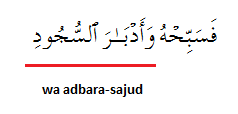
Illustration
- Joseph Islam
Also in 20:130, we note and instruction to the Prophet:
020:130
“Therefore
(O Muhammad), bear with what they say, and celebrate the praise of
thy Lord before the rising of the sun and before its setting. And
glorify Him some hours of the night and
at the two ends of the day that thou may find
acceptance”
052:049
And for
part of the night also praise thou Him,- and
at the retreat of the stars!
076:26
“And
during part of the night adore Him, and give glory to Him (a) long
(part of the) night”
(Please also see related article [2] and [3] below with regards the Tahajjud
prayer)"
[2] THE TAHAJJUD PRAYER
http://quransmessage.com/articles/tahajjud
FM3.htm
Therefore, given the above arguments from the Quran, I sincerely believe
that the interpretation above is absolutely feasible. Please also see my
perspectives on the term 'sujud' in the article below.
[3] WHAT IS THE QURANIC SUJUD
(PROSTRATION)?
http://quransmessage.com/articles/sujud
FM3.htm
10) B.
The author incorrectly translates 20:130, exposing a potential problem
in his theory, quote:
"Also, we
note in 20:130 that the two ends of the day (watarafa l-nahari) are used
as separate periods along with the period just before the setting of the
sun (Shamsi waqabla ghurubiha) which clearly indicates the period of Asr
prayers.
020.130
“Therefore be
patient with what they say, and celebrate (constantly) the praises of
thy Lord, before the rising of the sun (Arabic: Qabla taluhe- Shams -
i.e. Fajr), and before its setting (Arabic: Qabla gharubiha - i.e. Asr);
yea, celebrate them for part of the hours of the night, and at the sides
of the day (Arabic: Watarafa l-nahari - i.e. Fajr and Isha): that you
may have (spiritual) joy”
The word "atrafa" (ends/sides)
is actually an Arabic plural meaning 3 or more.
The author
is correct. 'Atraf' can refer to any sides, extremities of the day and 'Fajr'
and 'Isha' was merely to be quoted as examples. Therefore, the article
has been modified.
Note how it is different
to the dual form "tarafay" used
in 11:114. Thus, "atrafa" cannot
mean "two ends of the day". It more correctly means "3 or more
ends/sides of the day". Of course, once this correction is inserted into
the author's interpretation it causes a problem.
In my humble view, no such problem is
caused. Please see above where it was argued that verse 20:130 was
directed to the prophet and a reference to the Tahajjud prayer.
Note how also the author assigns a salat for
each time-point given EXCEPT "hours of the night". See point (15) later.
Thus, using the author's reasoning, we have:
1) before the rising of the sun = Fajr
2) before its setting = Asr
3) from hours of the night = ?
4) 3 or more sides/ends of the day = Fajr + Isha + ? (+? etc)
(1) This is
argued for and arguably evident from the verse.
(2) This is argued for and arguably
evident from the verse.
(3) A reference to other prayers not
specifically mentioned such as tahajjud (Please see response in section
(9) above).
(4) A reference to other prayers not
specifically mentioned.
Why The Quran has redundant and potentially misleading repitition is not
discussed by the author, e.g. why mention Fajr twice. From my
experience, 20:130 is a frequent cause of issues for those advocating 5
salat daily from Quran.
It has already been admitted that (4) can refer to other prayers which
include but are not restricted to the morning prayer (fajr). Verse
20:130 only singles out the 'fajr' (morning) prayer once by the Arabic
phrase "Qabla taluhe-
Shams"
11) B, C, D.
After a questionable translation of "wa"
in 2:238 as "especially", the author states, quote (bold and underline
emphasis mine):
"The prayers
are referred to as ‘salawaat’ which is plural (singular: salat).
Therefore by simple deduction there has to be clearly more than 1 prayer
in the day if this
is a reference to the daily prayers."
In 2:238 The Quran makes no reference to the "salawaat"
being "in a day"
The apriori position would arguably lean to the
context being 'a day' especially when
a particular prayer has been given
specific mention
(salaat al-wusta). To imply that salawaat cannot be
referring to the prayers in 'a day' but rather to any other number of prayers in
one's life can only 'arguably' be built on the premise to support a 2
prayer a day theory of the author which this one verse rejects in one
stroke or indeed another premise. It appears evident to me at
least that the author clearly finds himself in a difficulty himself.
Even if the apriori position that I have assumed is put aside, he is
still in the predicament that he has to explain what is the 'wusta /
middle prayer', a prayer that has been singled out for specific mention
in what the author believes his 2 prayer a day belief. There is
obviously no 'midpoint' in a 2 prayer belief. So what we will now see is
the author's attempt to overcome his difficulty to argue against the meaning
of 'wusta' in a manner possible including 'a figurative reading' that
would have the net result to detract from his immediate difficulty of
implying a 'middle prayer'.
thus the use of "if"
above is important to note. In a day is an assumption.
It is a very good assumption given the context.
Next, it is said,
quote:
"If the
literal meaning of 'wusta' is taken as ‘middle’ and which seems correct
in context..."
The author provides no reasoning/evidence why it "seems correct in
context".
The literal meaning of 'middle' has been comprehensively argued.
Therefore, it is incorrect to imply that I have provided no reasoning /
evidence as to why I have assumed this.
The author then references one usage (100:5) of the verb "WaSaTa"
(same root as the adjective/noun "WuSTa" in 2:238) to show that it can
mean a literal "middle". However, what the author fails to mention is
that every other occurrence of this root in The Quran shows it means
"middle" in the figurative sense, i.e. balanced,
conforming/equitable/just/excellent, average/moderate, most remote from
the extremes. See its other adjective/noun usage below:
The author clearly tends to
evade the obvious quandary he finds himself in, of dealing with a clear
example where the term 'wusta / wasat' has been used in a literal sense.
If the Quran provided absolutely no examples of 'literal' meanings of
'middle' or 'midmost, then the author may have had a point. However,
this is clearly not the case in the Quran and one is strongly inclined
to assume that the author's whole attempted rebuttal against
interpreting the term 'wusta' as middle in verse 2:238, is simply
because it absolutely nullifies his belief of a 2-prayer a day system.
i.e. there cannot be a 'middle' point of a 2 prayer system as is the
author's belief.
And as such, We have made you a WaSaTan nation... [2:143]
God will not hold you for your
unintentional oaths, but He will hold you for what oaths you have made
binding; its cancellation shall be the feeding of ten poor from the aWSaTi of
what you feed your family...[5:89]
The author clearly does not make clear that this verse can be read as
'midmost' implying an average which would not be a figurative reading.
The aWSaTu of
them said: "Did I not say to you: why do you not glorify God?" [68:28]
Therefore, in terms of simple probability, the adjective/noun "wasat"
in 2:238 more likely refers to the figurative meaning of "middle".
As shown, this is an
unwarranted suggestion given that the Quran clearly recognises the
adjective implying a midmost / middle reading literally.
Quote:
"As
can be seen, the middle (wusta) prayer is the central prayer and is the
one that approaches sunset or corresponds to the period of late
afternoon."
It should be noted that the author infers this "middle prayer" to refer
to "Asr" in late afternoon, but this is not the literal middle of the
day,
as that would be noon (i.e. Dhuhr).
There
is an unwarranted assumption here that the middle should be the 'midpoint' of
the day as opposed to the 'middle prayer' of a system of prayers. I
believe it is clear that if the context is 'prayers', then the most
obvious deduction is that the midpoint reference is to the 'middle
prayer' and not to the day.
Interestingly even in the
article's quoted part of Lane's lexicon it gives a use of "wusta"
referring to "the middle/midst of the sky" which also indicates noon.
The author has clearly
missed the Arabic which is a reference in the context of the 'sun' and
not in the context of prayers. The lexicon excerpt also clearly shows
the understanding of the term as 'the middle'. Thus, strictly the article means "middle" as in middle of the theorised
5 salat daily sequence, i.e. the 3rd one of the day, i.e. "Asr". Thus,
the so-called "middle prayer" is not in the middle of the day.
Again the premise of the
author's argument is false as the mid-point is that of the prayers of
the day and not 'the day' itself.
Also, technically if it is the "middle" salat, then we are not told in
The Quran which is the first salat of the alleged five, thus cannot
identify which one is the "middle".
The obvious argument for
the 'first prayer' would be that of the first prayer of the day i.e. .Fajr'
It could be inferred however that
the first salat of the alleged five would be the first one of the day,
i.e. salat al fajr, thus making "Asr" the "middle" salat.
This would be a very
feasible deduction. Ideally in
this argument, accompanying information showing when day begins as per
Quran would be helpful.
This is an unwarranted
expectation from the Quran when it should be clear to most what the
'first prayer' of the day would be. With respect, it is felt this is a very desperate
attempt to disprove what is obvious, simply so that the belief of the
author's 2 day salaat system can be argued for.
Quote:
"This
prayer has been given special attention and has been singled out for
mention in the ‘group’ of prayers (salawaat - plural)."
The author does not provide any reasoning/evidence for why it has
allegedly been singled out.
This statement assumes that every single command in the Quran should be fully explained
to the author's expectation, whilst this is
arguably not the case. The Quran only furnishes those details that it
deems
necessary
to impart. Therefore, this is an unwarranted statement by the author. This is likely because there is no
explanation from The Quran.
As
mentioned, the expectation to find a
fully detailed explanation on every command of God is unwarranted.
This is perhaps why the author (and others)
conveniently translate "wa" as
"especially", as simply translating "wa"
as "and" would make readers ask: why has the middle "salat"
been redundantly singled out when it is already included in "salawat"
mentioned previously? Hence, I suspect that by assigning a questionable
"especially" status, may help give some credence to this view.
Anyone who has translated one language to another would know the
difficultly experienced at times of capturing the best nuance when
translating.
After saying "guard the salawat"
it is redundant to say "and the middle salat",
as the latter is already included in the former.
This statement is directly refuted from the Quran. The Quran singles out
specifics from a general category.
For example, in the following verse, one
notes:
055:068
"In both of them (are) fruits
(Arabic: fakihatun) and (wa) date-palms
and (wa) pomegranates"
Here the conjunction 'wa' (and) when used
with date-palms and pomegranates only clarifies the
'fruits', seemingly providing additional emphasis and is not read /
understood as separate from the category of fruits (fakihatun).
Another problem for the author's view arises with the following verse:
Guard over the salawat;
and the middle salat;
and stand/observe dutifully for God. [2:238]
So if you fear then on foot or
riding, then when you
are secure then remember God as He has taught you
what you did not know. [2:239]
Does 2:239 refer to "the middle salat"
or "salawat"? The
reference would simply be regarding all the salaat.
As shown by the example
above, when the Quran provides special mention to something, it does not
mean that it is distinct and separate from its main category.
It will be an
assumption to choose one over the other, although the flow and structure
seems to favour "al salat al wusta"
over "salawat" in my view. For
an explanation of my view, please see this post.
As mentioned, the author's whole argument is based on a faulty premise
of not understanding how the Quran deals with an object from its general
category.
Further, the Arabic form of the term "al
salat al wusta" in 2:238 is different to the form "salat
al fajr" and "salat al isha"
in 24:58, and clearly indicates it is a description whilst the latter
two are a specific reference, i.e.
salat al fajr ~ salat (of) fajr/dawn
salat al 3sha ~ salat (of) 3sha/evening
al salat al wusta ~ the wusta/balanced salat
Many of those who advocate a middle salat incorrectly
refer to it as "salat al wusta"
as if to imply it occurs in the same form as "salat
al fajr"/"salat al isha" in Quran.
The form does not deter that the fact that salaat could be a reference
to the 'middle prayer'. In fact the form presented arguably implies the
prayer as a well-known prayer of the day.
As a side note, "wusta" has
never been a reference/name for a salat in
Traditional Islamic history as far as I'm aware.
With respect, again the author is
attempting to lean on
Islamic secondary
sources
to justify his argument.
Whether or not the prayer
was known as 'Wusta' or not is irrelevant from a Quran's perspective
which is the earliest Islamic document of a religious community to whom
the Quran was revealed. And for those that
argue it refers to a clear/known period of the day, they should note
that there is variance in Traditional sources about which salat it
may refer to.
Again, the author's appeal
to
Islamic secondary
sources is superfluous to an analysis from the Quran.
12)
Commenting on 11:114, quote:
"...we were
also informed about the prayer at the approach of the night (wa-zulafan
mina al-layl)..." i.e. evening twilight.
The author follows up by clarifying what this period refers to, quote
(underline mine):
"..therefore the period of maghrib can
be correctly deduced as it is a period which precedes
the onset of night (Arabic: layl) and
after sunset."
i.e. evening twilight.
In other words: "zulafan* mina
al layl" = approach* of
the night = maghrib = evening twilight, and this period precedes night,
i.e. is NOT part of the night. Also
see point (2) above to confirm this.
*Arabic plural, i.e. 3 or
more, thus author should actually render it as "approaches"
Please see my response to (2) above where I have responded to the author,
which he has used as an erroneous premise to raise his contentions in this section.
Unfortunately for the author the Arabic "min/mina"
in "zulafan mina al
layl" is a partitive preposition in this construction, thus the
"approaches" must be from (i.e. a part of) the night/layl.
To evidence this point, please see the below references:
'An Introduction to Classical and Koranic Arabic' by W.M. Thackston
http://islamicbulletin.org/free_downloads/quran/thackston_arabic.pdf
p7
Quote: "min(a) (+genitive)
from/among/amongst/in (in a partitive sense)"
'A Grammar of Classical Arabic' by Wolfdietrich Fischer
https://ia600806.us.archive.org/22/items/AGrammarOfClassicalArabic/AGrammarOfClassicalArabic.pdf
p90
Quote: "If the sense is partitive, it is combined with the dependent
genitive by min"
p160
Quote: "In combination with terms that denote place and time, min refers
to a certain segment of the place or time, e.g. min al-layli
'in a part of the night"
The
author's faulty premise which was rebutted in 8(d) has formed the
erroneous premise of this section. I clearly recognised that "a
gradual movement into the night (layl) is
certainly implied by
the Quran and arguably the onset of night would not necessarily mean
to imply total darkness."
Note that in 11:114 "al layli"
in "zulafan mina al layli" is in
the genitive case, thus is meant in the partitive sense.
The author has simply attempted to part with superfluous linguistic
arguments which have little relevance with the fact that the gradual
movement into the night has already been recognised in my articles. The
meaning of the preposition 'min' was never in dispute. The author has
erroneously presented my position as one implying where night and day
are separated distinctly when I have rather argued for a 'gradual'
movement.
For
example, in the fasting article below, I have clearly recognised that
'sunset' and 'night' are not the same periods and are indeed separated
by a period of 'gradual movement' into the night. Therefore, a period
immediately before the onset of the night
would be gradually meshed into the night and be perfectly reconciled
with the partitive use of 'min' which implies an overlap of some
fraction with what follows after it (i.e. layl).
Therefore the construction
'wazulafan minal'layl'
can perfectly be understood as an approach to a 'layl' (night) which
itself is a gradual process.
[1]
FASTING IS PRESCRIBED UNTIL NIGHT NOT SUNSET
http://quransmessage.com/articles/fasting till
night FM3.htm
Thus, this finding contradicts the article.
This is wholly disputed and is a conclusion merely based on a
misrepresentation of my position and erroneous premises
which have been shown above.
therefore
13) B, C, D.
Quote (underline mine):
"The
Arabic root word Zay-Lam-Fa (from the word wazulafan) means to be close
to in position or approaching, in
this case, the end of the day..."
Note that the underlined part is an interpretative assumption, as "near
parts" (zulafan) needs a
reference point, i.e. near to what?
This interpretation is clearly backed up by the context. The
interpretation of the end of the day is clearly indicated by the mention
of 'layl' (night) which is correct in the immediate context. If one were
to say obtain two apples from Shop A and a 3rd apple from or near Shop
B, would the third apple be relevant to Shop A or Shop B? It would be
evident that Apple 3 would have relevance to Shop B and would be the
immediate reference point.
Again, the author's immediate difficulty of his 2-salaat a day belief is
exposed by verse 11:114 which clearly recognises at least 3 prayers. 2
prayers at the two ends of the day are clearly separated by another.
Therefore, the author's contentions appear laboured where there are
verses which clearly indicate more than 2 prayers.
And in 11:114 the ONLY reference
point given prior is "two ends of the day", thus that is the more
correct reference point according to the Arabic.
This is an unwarranted conclusion as shown
above. The author has
interpreted his own reference point of one end of the day, i.e. the
latter end of the day.
Again, please see context. You may see here for
further elaboration.
Whatever the interpretation, it remains a
fact that this particular verse clearly recognises at least 3 prayers in
a day which evidently refutes the author's belief of 2 prayers in a day,
which as is argued in my responses, the premise of the author's main
rebuttal.
14) B, C.
Whilst making a case for "Isha"
salat, the author cites examples from The Quran that allegedly reference
this salat,
e.g. 3:17, 39:9, 25:64. It should be noted however the word "salat"
(or its root SLW)
do not appear in these verses. The reference to "salat"
is therefore an unstated assumption.
The fact that a night prayer exists (Isha)
is not disputed by either myself or the author (Wakas). This is made
explicit in verse 24:58. Therefore, any other references would only
support this prayer by inference and not deny it. It is asserted that my assumptions are not unreasonable given the fact that a night prayer is
undisputed.
15) B, C, D.
In "the tahajjud prayer"
section a significant inconsistency in the author's argument is exposed,
quote:
"This
particular prayer has only been mentioned once in the Quran and has been
enjoined on the Prophet. It has been enjoined to a singular person and
from the context, it is clear that this command is directed at the
Prophet. This is not for the believers as a specific prayer to undertake
albeit believers can pray as much as they desire without any
restrictions given by scripture except that one does not overburden
oneself and keeps a balance (73:20)."
The article then highlights the singular address in 17:79 and tries to
make the case that this "tahajjud prayer"
is only for the prophet whilst seemingly forgetting that the prior verse
17:78 is also in the singular address but was
used by the author to clearly imply it is an instruction for all
believers!
At no place in verse 17:78 does it mention that the prayers
are only for the prophet. Rather it is given as a general directive.
However in verse 17:79, an additional prayer is mentioned and the Quran
clearly singles this out as an additional prayer
'FOR YOU'
(laka) i.e.
the prophet. From this one statement, the context is changed for the
additional prayer. There is absolutely no warrant or basis for the
contention raised by the author which completely dismisses context. A
dedicated article [2] is provided discussing this extra prayer for the prophet.
[2] THE TAHAJJUD PRAYER
http://quransmessage.com/articles/tahajjud
FM3.htm
To make matters worse, the author again cites 50:39-40 and 20:130 but
this time uses them to imply parts of them are only applicable to the
prophet whilst previously the author used the same verses to extract
timings that were applicable to all believers. In
sections 9 & 10 it was clearly mentioned why these verses were
applicable to the prophet with the mention of an additional prayer.
Notwithstanding the 'tahajjud prayer', the prophet did not perform other
prayers different from the believers. Therefore, an overlap is expected
in those prayers which are common to both the prophet and the believers.
Since the author does not explain his methodology for determining what
verse is applicable to whom (i.e. prophet and/or all believers), it
could be that what underpins this selective approach is simply
confirmation bias.
This is denied as I hope my previous responses have made evident. I
humbly feel that I have presented clear rationale within my responses as
to which verses have been used and why. On the other hand, it
appears quite evident that the author (Wakas) has used confirmation bias
to raise contentions against clear verses to support his own 2 prayer a
day belief.
It should be noted that to my knowledge, the only plural address to
believers for a timed salat verse
is 24:58, wherein only "salat al fajr"
and "salat al isha" are
mentioned.
This is commonly not mentioned in articles. Once
again, it has been mentioned in a number of my writing and articles that
the mention of named prayers in verse 24:58 is not to establish prayers
but are used as reference points to address other matters. Please see
article [4] below:
[4]
ARE THERE 3 OR 5 PRAYERS IN THE DAY?
http://quransmessage.com/articles/3 or 5
prayers FM3.htm
16) B, D.
A more accurate translation of 17:79 is shown below:
Establish the salat at
the setting of the sun to the darkness of the night; and the reading (of)
dawn; indeed, the reading (of)
dawn is witnessed. [17:78]
And from the night so remain awake
with it additionally
for yourself, perhaps your Lord will raise you (to) a status
praiseworthy. [17:79]
The "with it"
(Arabic: bi hi)
refers to a preceding masculine noun, and thus can ONLY refer to
"reading" (Arabic: quran).
Note that "salat" is a feminine
noun. Thus, the idea of "the tahajjud prayer"
is not possible unless one considers it as a reading (also see 73:20).
This statement of the author appears confused.
Firstly, the author has incorrectly translated 'tahajjud' as
'remain awake' with absolutely no warrant to do so. Secondly, the 'tahajjud'
is considered as an 'addition' (nafilatan), so the question is what noun
/ thing is it an addition to? Fajr has already been mentioned in verse
17:78 and argued in section 6 as a time for prayer where the Quran is
used. Therefore, the context is prayer and thus, the addition' is a
reference to an 'additional prayer' (tahajjud) which once again, does not
preclude reading / reciting the Quran. However, to remove the concept of prayer from the
translation of verse 17:79 altogether, is wholly unwarranted.
17)
Quote:
"50:39 ...in
the night-time hymn His praise, and after the (prescribed) prostrations
(Arabic: wa adbara-sajud)”
From this the author deduces: "After
the prostrations here can only refer to Isha prayers."
The above deduction is an assumption and is not the only option.
The only option does not mean that the option that the author (Wakas)
infers is the most viable. What is most crucial is what 'option' bears
the strongest argument within a given context.
See
point (9) above.
Indeed, please see section 9 where this contention has been responded to
and made clear why the prescribed prostrations are a reference to Isha
prayers in the particular context.
The Arabic more literally says "and (at) ends/backs
(of) the sujud/prostration/submission",
as "sujud" is singular here.
This construction appears nonsensical. Once again, please see section 9
where the terms are discussed including an article presented on the
meaning of sujud from the Quran.
18) B, C, D.
Readers should note that by the end of the article, no definitive
timings are concluded, i.e. start point AND end point for each alleged salat.
The Quran only stipulates periods of the day in which prayer needs to be
established. The Quran does not appear to provide the need to give a
semblance of hours and minutes. This would be an unwarranted
expectation.
This issue is prevalent in all articles advocating 5 daily salat.
It is thus sometimes argued that The Quran only makes reference to time
periods, and therefore leaves it to us to determine the specific times.
As to why this should be a problem only implies that the author (Wakas)
sees the Quran as needing to furnish the reader with all sorts of
stipulated minutiae to general commands. As a crude example where God
asks His servants to eat of the lawful and good, He does not inform
believers how to eat. The author's logic based on his argument would
imply the need to expect the Quran to furnish details about how to eat
(chopsticks, knives and forks, hands etc) and all other minutiae
associated with general commands. This would be an unreasonable
expectation. The Quran is not averse to furnishing details where it
deems fit. One only has to note the details of 'ablution' which the
Quran deems fit to elaborate on (5:6; 4:43) in much detail.
It should be noted that this is an assumption, a forced one, resulting
from holding the 5 salat daily
view.
Not at all. It is an assumption based on the fact that the Quran states
that God does not run out of words (31:27) and if He deemed fit to
stipulate exact times in some semblance of hours and minutes or start
and finish periods, He would
have done so. This view must be balanced with The Quran's claims of being clear,
detailed etc see here. Indeed
it does, but the author is expecting the Quran to furnish details to
what he expects and not what the Quran deems appropriate to remain
silent on. This is no different from many traditionalists that
attempt to 'fill in the gaps' to general commandments. Please see
article
[5]
below.
[5]
UNKNOWN TOWNS AND NAMES - WHY FILL IN THE GAPS?
http://quransmessage.com/articles/unknown
towns and names FM3.htm
Interestingly, in such an explanation this may make it difficult to
perform a coherent salat in
a group, i.e. the start/end point is not defined thus would have to be
agreed beforehand. Also, since the times are not defined in such a view,
an individual could spend most of the day performing salat,
with little or no break inbetween periods. Further, in such a view, it
could be the case that a person is performing their "Asr salat" and
another could be performing their "Dhuhr
salat", both at the same time of the day.
At a time during prophetic revelation, where there were arguably no
digital watches to tell the time in hours and minutes, a community of
believers arguably agreed upon a general method of prayer from a basic
stipulation by the Quran as to the periods in which prayer should be
established. Even today, where there are some differences, believers
generally congregate at distinct parts of the day to establish their
prayer without too much trouble. It doesn't appear to be 'rocket
science' but demanding superfluous details 'generally' appears to be no
different from the oft mentality that the Children of Israel displayed
when they were asked to simply sacrifice a cow (2:67-71). It is all too
apparent from those verses what transpired when they attempted to
elicit finer and finer details of a general religious commandment which
led them to the point that it became nearly impossible for them to
perform the task.
Please see related article
[6] below:
[6]
DO NOT COMPLICATE RELIGION - WISDOM FROM SURAH BAQARAH
http://quransmessage.com/articles/wisdom -
baqarah FM3.htm
Some advocates attempt to remove this problem by citing precedent, i.e.
the timings allegedly instituted by the earliest Muslim community that
have been passed down through the generations can be used by believers
today as an example to follow. Some may find this explanation
acceptable.
Any practice that fulfils the general stipulations of the Quran can be
used as best practice. There is a difference between 'best practice' and
something being 'religiously prescribed'. I do not see any reason to
're-invent' the wheel to a practice of prayer which aptly fulfils the
Quran's requirement to establish prayer. It is only when the Quran's
stipulations are contravened, that a practice can be rejected from a
scriptural perspective. None of the general practices of congregational
prayer appear to contradict the general guidance proffered by the
Quran with regards establishing salaat. Please see below some
aspects of salaat that the Quran expects:
-
Need for ablution (4:43; 5:6)
-
A need for a direction - Qiblah, specific for the ‘believers’ (Mu'mins)
(2.143-44)
-
Garments (7:31)
-
Allusion of times:
(4:103; 11:114; 17:78; 24:58; 30:18; 2:238: 20:58)
-
That prayers must be observed on time (4:103)
-
Followers of the previous scripture to observe their Qiblah and the
Believers (Mu’mins) their own Qiblah (2:145)
-
Prayer involves
prostration (Sujood - 4:102; 48:29)
-
There is more than one prayer (Prayer in plural used - Salawat)
(2:238)
-
There is a general form to prayer (2:238-39).
-
Standing position (3:39; 4:102)
-
Bowing down and prostrating (4:102; 22:26; 38:24; 48:29)
-
Form is not required during times of emergencies, fear, and unusual
circumstances (2:239)
-
A mention of a call to prayer and congregation prayer (62:9)
-
A warning not to abandon prayer as was done by people before
(19:58-59) but to establish prayer (Numerous references)
-
The purpose of prayer - To remember God alone (6:162; 20:14)
-
Prayer involves utterance (4:43)
-
The purpose to protect from sins (29:45)
-
What to do in danger and the shortening of prayer (4:101)
-
Garments and mention of a Masjid, or a place of prayer (7:31)
-
The tone of prayer (17:110)
-
There is a leader of prayer (4:102)
With respect, the author has not hitherto provided any concrete argument
that argues against the religious need to establish prayers more than 2
times a day. Sadly, the arguments hitherto have been based on faulty
premises, unwarranted assumptions of my position and baseless
expectations from the Quran to furnish details in accordance to his
view.
19) B, C, D.
Even if we accept it is left to us to determine the specific times,
the author now implies that this could be an option one
should note the inconsistent/asymetrical timings, i.e. some salat have
specific start points some do not, some have specific end points some do
not, some could have specific start and end points some may not, there
could be differences in length of the time periods of each one etc.
This has never been a major problem in practice and one cannot fathom
how certain prayers that can be determined more specifically such as 'fajr'
would be a problem for other prayer times / periods which can be
determined by best inference, such as 'Asr'.
Of course there is no statement in Quran that the time periods must be
equal in length,
The author appears to recognise the weakness in his own thought which
can be easily responded to and thus pre-empts an obvious rebuttal or must have an identifiable start and/or end point but
one would have thought this information would make them much more
practicable, especially for groups.
Again, it seems not to have caused much trouble in practice and even
today, 5 general periods of prayer can easily be determined and agreed
upon. The premise of the author's contention appears to be based on his
own inability to forgo an unwarranted expectation for the Quran to
furnish him details to general commandments.
A relatively common problem in such articles is that whilst verses are
cited to indicate times, the specific times are not clearly explained
and defined.
Again, the author Wakas appears to labour the same point of expecting
from the Quran details it does not deem fit to furnish.
This is likely because specifics do not exist. For clarity,
it is preferable to have the following basic information made clear IF
it is available, for each salat:
name/reference for salat as
per Quran, if any (verse references for this)
salat time
range: start point and end point (verse references for this)
20) B, C, D.
It should be noted that according to the 5 salat daily view, a salat called
"Dhuhr" and a salat called
"Asr" are claimed to be due from noon onwards, however according to
24:58 it was common practice for believers within their households to
discard their clothes at/from noon (likely due to the heat*),
and this period of undress is described as "private parts/times" (3awrat)
for us. During these private times others are asked to seek our
permission in order to mingle with us. Thus, questions arise: when is salat meant
to be offered in this private time of undress? Even
today in many hot countries individuals have siestas but are able to
read their prayers of Dhuhr and Asr around their time of rest.
Do
believers uphold the alleged Dhuhr/Asr salat privately? They
may do or they may congregate. A siesta is not a religious prescription
but the Quran merely makes use of a periods of noon-day rest and night
(before Fajr) where one is in relaxed attire and mood during sleep to
provide guidance for certain groups of people to ask permission to come
into their areas of rest.
Can
they uphold them naked?
I find this a most ridiculous question and makes me question the
credibility of the author's general arguments.
A state of general undress to a more relaxed attire does not mean they
are naked. Furthermore, privacy is the focus of the verses. Whether
individuals pray before the siesta and wake up later in the day for Asr
is perfectly possible. Do they uphold Dhuhr, then undress, then
re-dress and uphold Asr, then undress etc - is this what is being
suggested?
With respect,
I cannot fathom the extent of the author's reasoning and the type of
questions he has deemed fit to ask. Even today, many find time to rest
between the period of Dhuhr and Asr.
It could be argued that we are meant to apply some sort of common sense,
I would kindly suggest this also and would have expected the author to
have done this and not present this as a basis for desperate contention. for example, when noon arrives, one would uphold both these salat immediately
or soon after, then go to their homes (or if already in the home) and
discard their garments, but unfortunately for such an explanation 24:58
states at/from noon. Perhaps some might accept this explanation. Of
course, some advocates of 5 salat daily argue for the alleged "Dhuhr"
and "Asr" time periods to extend well into the afternoon and even until
start of sunset.
*It should be noted that the
hottest part of the daytime tends to be post-noon, i.e. in the
afternoon. At noon, direct sunlight is at its maximum, however it takes
some time for the sun to heat up the atmosphere (see here).
I feel the author is finding any desperate attempt to discredit the 5
prayer salaat. With respect, nothing in what the author has presented
thus far cogently disputes the need for 5 prayers as established by the
Quran. However, many verses of the Quran dispute the author's belief of
salaat to be performed twice a day.
In
conclusion, it is my humble opinion that the author has failed to
successfully contend with the argument for the Quranic belief of the
prescription of 5 prayers a day. It is respectfully felt that the
author's (Wakas's) own premises have been exposed as have the crux of
the arguments he has put forward.
The main
contentions noted with the gist of the author's (Wakas's) arguments are:
-
The
author has often relied on unwarranted premises.
-
The author has often relied on unwarranted expectations from the Quran
to furnish him details in the manner he expects and has failed to
appreciate Quranic silence.
This is no different from many traditionalists that attempt to 'fill in
the gaps' to general commandments.
-
The author
has presented futile impressions from Islamic secondary sources which
are irrelevant in a Quranic discussion.
-
The
author has often misrepresented my position to base his erroneous
assumptions on, from which he has derived unwarranted conclusions.
REFERENCES:
[1]
FASTING IS PRESCRIBED UNTIL NIGHT NOT SUNSET
http://quransmessage.com/articles/fasting till
night FM3.htm
[2] THE TAHAJJUD PRAYER
http://quransmessage.com/articles/tahajjud
FM3.htm
[3] WHAT IS THE QURANIC SUJUD
(PROSTRATION)?
http://quransmessage.com/articles/sujud
FM3.htm
[4]
ARE THERE 3 OR 5 PRAYERS IN THE DAY?
http://quransmessage.com/articles/3 or 5
prayers FM3.htm
[5]
UNKNOWN TOWNS AND NAMES - WHY FILL IN THE GAPS?
http://quransmessage.com/articles/unknown
towns and names FM3.htm
[6]
DO NOT COMPLICATE RELIGION - WISDOM FROM SURAH BAQARAH
http://quransmessage.com/articles/wisdom -
baqarah FM3.htm
[7] THE FIVE PRAYERS
FROM THE QURAN
http://quransmessage.com/articles/the five
prayers from the quran FM3.htm
RELATED MATERIAL:
RELATED FORUM DISCUSSION -
Comments on Five Prayers & Meaning of Sujud - Wakas
http://quransmessage.com/forum/index.php?topic=477
PRAYER RELATED ARTICLES
http://quransmessage.com/articles/prayer
FM3.htm
PRAYER RELATED Q&As
http://quransmessage.com/articles/q&asprayer
FM3.htm
PRAYER RELATED FACEBOOK POSTS
Quranic Prayers
The Prayers of the Believers
Never Underestimate the Importance of Prayer
Prayers in General
A Personal Prayer
Was Ritual Prayer a Practice Invented Later?
The Tradition of Prayer - An Old Practice
Last updated: 1st June 2014
JOSEPH ISLAM
#####
Please note that the above highlighted problems may not be the only
ones. It is hoped that this article will allow readers to weigh and
consider information more accurately. The reader is recommended to
re-read and reflect upon the findings of this work. All feedback is
welcome, especially corrections. Thanks.
Tools/Resources/Books used:
www.StudyQuran.org
Project Root List -
Quran concordance, grammar and dictionary
Quranic Arabic Corpus
'Dictionary of The Holy
Quran' by Abdul Mannan Omar
Study Method
This work would not have been possible
without the many people who have contributed to this topic, and
without the resources now available to anyone wishing to study
The Quran in detail. For these stepping stones, I am indebted
and truly thankful.
IMPORTANT DISCLAIMER:
This work
reflects my findings and personal understanding, as of February
9th 2014. Seeking knowledge is a continual process and I will
try to improve my understanding of the signs within 'the
reading' (al quran) and
out with it, unless The God wills otherwise. All
information is correct to the best of my knowledge only and thus
should not be taken as a fact. One should always seek knowledge
and verify for themselves when possible: 17:36,
20:114, 35:28, 49:6, 58:11.
And do not
follow what you have no knowledge of; surely the hearing, the
sight and the heart, all of these, shall be questioned about
that. [17:36]